
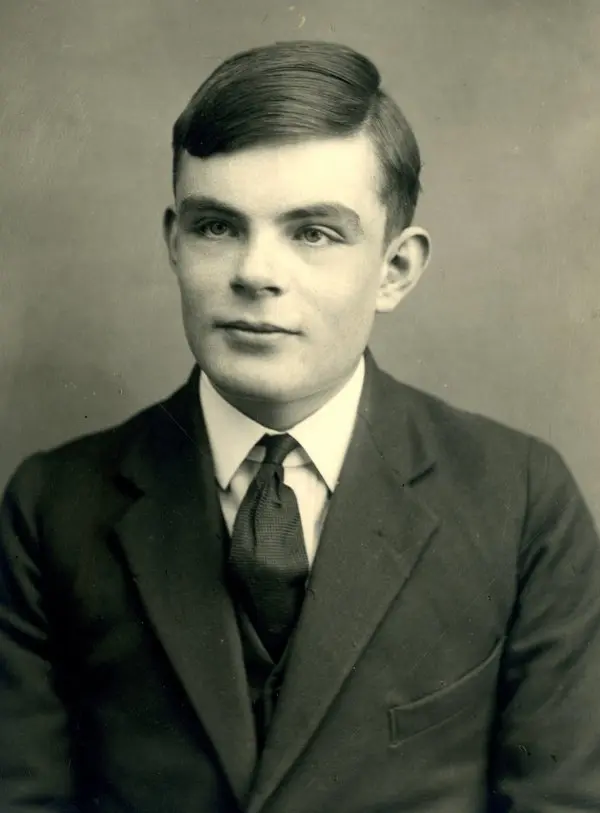
In Memory of
Alan Turing
1912 – 1954 · Age 41

Tribute
Alan Turing was not just a brilliant mind, but a beacon of resilience and insight in times of turmoil. His contributions during World War II, especially at Bletchley Park, were pivotal in shaping the outcome of the conflict. The complexity of his work in breaking the Enigma code was matched only by his ability to envision a future where machines could think — a concept that still fascinates and drives us today.
Beyond his extraordinary intellect, Alan embodied the spirit of curiosity and courage, often challenging societal norms with quiet strength. His legacy is not only etched in the circuits of the computers we use but also in the very fabric of how we approach problem-solving and innovation. The pain of his untimely passing leaves a void, yet his story endures, inspiring countless generations to embrace their uniqueness and pursue knowledge relentlessly. Turing’s life is a testament to the power of the human spirit — a reminder that brilliance and kindness can change the world.
Biography
He contributed to the development of the Manchester Mark I, one of the earliest electronic computers. His pioneering work laid the groundwork for modern computing, and his conceptual framework for algorithms remains integral to computer science today.
Born on 23 June 1912 in London, Alan Turing showed early signs of brilliance in mathematics and science. He graduated from King’s College, Cambridge, with a first-class degree in mathematics, and went on to attain a doctorate from Princeton University in 1938. With the outbreak of World War II, Turing’s genius came to the forefront as he joined Bletchley Park, where his extraordinary skills in cryptanalysis played a pivotal role in decoding the Enigma machine, substantially aiding the Allied war effort.
Turing’s impact extended beyond the war; he was an advocate for the potential of computers, envisioning their capabilities long before advancements in technology caught up with his theories. In the post-war years, his contributions to computing shaped the foundations of artificial intelligence and machine learning, fields that continue to evolve and expand.
Tragically, Turing’s life was cut short when he died on 7 June 1954, in what was ruled an accident, but his legacy has grown substantially since his passing. Posthumously recognized for his immense contributions, Turing has become a symbol of both brilliance and tragedy, representing the struggles faced by those who dare to challenge societal norms. His life story serves as an inspiration, reminding us of the importance of intellectual freedom and the celebration of diversity in all its forms. Turing’s name endures in the annals of history, forever celebrated as the father of computing and as a pioneer whose legacy will influence generations to come.
Condolences & memories
Sign in to leave a condolence message or share a memory.
Sign in to leave a messageBe the first to leave a condolence message.
Related articles

Remembrance Ideas
Memorial Quotes and Sayings for Remembering a Loved One

Remembrance Ideas
How to Preserve a Loved One’s Legacy for Future Generations

Remembrance Ideas
Anniversary Remembrance Ideas: How to Honor a Loved One on Special Dates

Remembrance Ideas
How Digital Memorial Pages Help Families Remember Together